
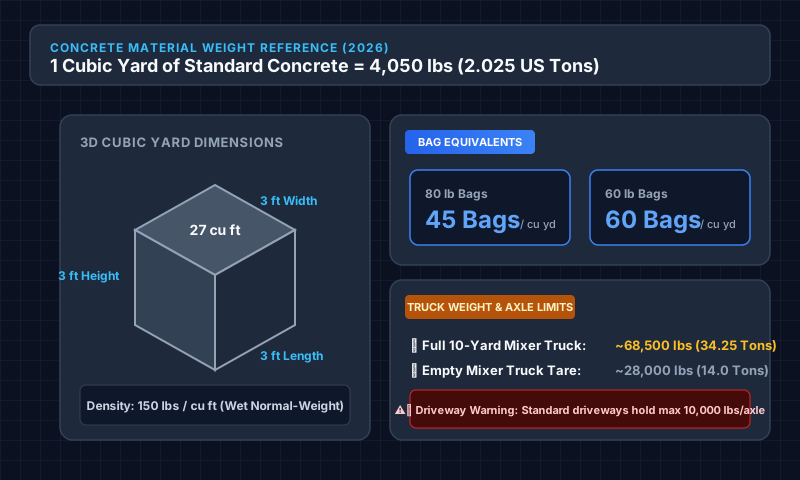
A standard cubic yard of normal-weight concrete weighs approximately 4,050 pounds (2.025 US tons) wet, or roughly 150 pounds per cubic foot. Once fully cured over 28 days, hydration and water evaporation reduce the finished dry weight by roughly 2% to 4%, settling at approximately 3,900 to 3,950 pounds per cubic yard.
Quick Rule of Thumb: When estimating hauling capacity, dumpster rentals, or trailer payloads, always round up to 2 US tons (4,000 lbs) per cubic yard. A standard half-ton pickup truck (1,500–2,000 lb payload) can safely haul only 0.35 to 0.45 cubic yards of concrete.
Concrete Weight & Truckload Calculator
Calculated concrete weight takeoff
| Metric / Unit | Amount / Equivalent |
|---|---|
| Cubic Yards | - |
| Cubic Feet (Volume) | - |
| Total Weight in Pounds (lbs) | - |
| Total Weight in US Tons | - |
| Equivalent 80 lb Bags (Standard Heavy) | - |
| Equivalent 60 lb Bags (Standard Slabs) | - |
| Equivalent 50 lb Bags (Fast-Setting Quikrete) | - |
| Ready-Mix Mixer Truck Loads (10 yd cap) | - |
Request Local Provider Options
Enter your ZIP code or city to start a quote request. Provider availability is not guaranteed.
How Much Does a Yard of Concrete Weigh by Mix Type?
Not all concrete mixtures weigh the same. The exact density depends primarily on the type and size of aggregate (crushed granite, limestone, gravel, or expanded shale) and the air-entrainment percentage used in batching:
| Concrete Mix Type | Density (lbs / cu ft) | Weight per Cubic Yard (lbs) | Weight in US Tons | Common Construction Uses |
|---|---|---|---|---|
| Standard Normal-Weight (3,000–4,000 PSI) | 145 – 150 lbs | 3,915 – 4,050 lbs | 1.96 – 2.03 Tons | Driveways, patios, standard slabs, footings |
| High-Strength Commercial (5,000+ PSI) | 150 – 155 lbs | 4,050 – 4,185 lbs | 2.03 – 2.09 Tons | Heavy equipment pads, commercial columns, bridge decks |
| Structural Lightweight Concrete | 90 – 115 lbs | 2,430 – 3,105 lbs | 1.22 – 1.55 Tons | Upper-floor multi-story slabs, lightweight precast panels |
| Insulating Lightweight Concrete (Cellular / Vermiculite) | 35 – 85 lbs | 945 – 2,295 lbs | 0.47 – 1.15 Tons | Roof decks, radiant floor underlayments, void fill |
| Heavyweight / High-Density Concrete (Hematite / Barytes) | 180 – 220 lbs | 4,860 – 5,940 lbs | 2.43 – 2.97 Tons | Nuclear radiation shielding, medical vaults, counterweights |
Cubic Yards to Pounds, Tons, and Bag Counts Conversion Chart
If you are planning to mix concrete by hand or order pre-bagged concrete from Home Depot, Lowe’s, or Menards, use our interactive concrete unit converter or this quick reference table for standard 80 lb, 60 lb, and 50 lb bags:
| Cubic Yards | Volume (Cu Ft) | Total Weight (lbs) | Total Weight (Tons) | 80 lb Bags | 60 lb Bags | 50 lb Bags |
|---|---|---|---|---|---|---|
| 0.25 yd³ | 6.75 cu ft | 1,013 lbs | 0.51 Tons | 13 bags | 17 bags | 18 bags |
| 0.50 yd³ | 13.50 cu ft | 2,025 lbs | 1.01 Tons | 26 bags | 34 bags | 36 bags |
| 1.00 yd³ | 27.00 cu ft | 4,050 lbs | 2.03 Tons | 45 bags | 60 bags | 72 bags |
| 2.00 yd³ | 54.00 cu ft | 8,100 lbs | 4.05 Tons | 90 bags | 120 bags | 144 bags |
| 3.00 yd³ | 81.00 cu ft | 12,150 lbs | 6.08 Tons | 135 bags | 180 bags | 216 bags |
| 5.00 yd³ (20×20 Slab) | 135.00 cu ft | 20,250 lbs | 10.13 Tons | 225 bags | 300 bags | 360 bags |
| 10.00 yd³ (Full Mixer Truck) | 270.00 cu ft | 40,500 lbs | 20.25 Tons | 450 bags | 600 bags | 720 bags |
Bag-count method: Counts are based on finished yield, not dry bag weight: 0.60 cu ft per 80-lb bag, 0.45 cu ft per 60-lb bag, and 0.375 cu ft per 50-lb bag. One cubic yard is 27 cu ft, so the 50-lb calculation is 27 ÷ 0.375 = 72 bags. Product yields vary; confirm the data sheet on the exact mix you buy and add a project-specific waste allowance.
How Much Does a Ready-Mix Concrete Truck Weigh?
Before ordering ready-mix concrete delivered to your property, it is critical to understand the total gross vehicle weight (GVW) of a commercial mixer truck to prevent cracking your existing driveway or collapsing underground utilities:
- Empty Concrete Truck (Tare Weight): A standard 3-axle to 4-axle ready-mix truck weighs between 26,000 and 30,000 pounds (13 to 15 tons) empty.
- Payload (Concrete Wet Weight): A full 10-yard load adds 40,500 pounds (20.25 tons) of wet concrete.
- Total Loaded Weight: A fully loaded concrete truck weighs between 66,000 and 70,500 pounds (33 to 35.25 US tons).
Driveway access warning: A loaded mixer is much heavier than a passenger vehicle. Do not assume an existing driveway, curb, culvert, septic field, or buried utility can support it. Ask the ready-mix supplier and your contractor to approve the access route; when access is uncertain, compare a concrete pump truck or buggy.
Wet vs. Dry Concrete: Why Does Weight Change?
When concrete is first batched at the plant, it contains water required for chemical hydration and workability (slump). In standard 4,000 PSI concrete, approximately 250 to 300 pounds of water is added per cubic yard.
During the first 28 days of curing:
- Roughly half of the mix water chemically combines with Portland cement to form durable calcium silicate hydrate (C-S-H) crystals.
- The remaining free water slowly evaporates through microscopic pores in the surface.
- This evaporation causes a net weight loss of 75 to 150 pounds per cubic yard (about 2% to 3.5% of total volume weight).
How to Calculate Concrete Weight: The Mathematical Formula
To calculate the exact weight of any concrete slab or project, follow this 3-step formula:
- Calculate Volume in Cubic Feet:
Volume (cu ft) = Length (ft) × Width (ft) × (Thickness in inches ÷ 12) - Convert to Cubic Yards:
Cubic Yards = Volume (cu ft) ÷ 27 - Multiply by Density:
Total Weight (lbs) = Cubic Yards × 4,050 lbs(orVolume in cu ft × 150 lbs)
Example: For a 10×10 shed slab poured 4 inches thick:
- Volume = 10 × 10 × (4 ÷ 12) = 33.33 cubic feet = 1.23 cubic yards.
- Total Weight = 1.23 cu yds × 4,050 lbs = 4,982 pounds (2.49 US Tons).
- Bag equivalent by product yield = 33.2 cu ft ÷ 0.60 or 0.45 = 56 bags (80 lb) or 74 bags (60 lb), before waste.
Public References
- QUIKRETE Concrete Mix technical data sheet — published yields for 50-, 60-, and 80-lb bags.
- QUIKRETE concrete calculator — manufacturer bag-count cross-check.
Frequently Asked Questions About Concrete Weight
How much does a 5-gallon bucket of concrete weigh?
A standard 5-gallon bucket filled to the brim with wet concrete weighs approximately 100 to 105 pounds (about 0.67 cubic feet × 150 lbs/cu ft). This is equal to roughly one and a quarter 80-lb bags.
Can my pickup truck carry a yard of concrete?
No, standard half-ton pickup trucks (Ford F-150, Chevy Silverado 1500, Ram 1500) have a maximum payload capacity of 1,500 to 2,300 lbs. One full cubic yard of concrete weighs 4,050 lbs, which will dangerously overload your rear suspension and brakes. To haul a full yard of concrete in bags or bulk, you need a heavy-duty one-ton truck (F-350, 3500 series) with a payload rating exceeding 4,200 lbs.
How much does 1 cubic foot of concrete weigh?
One cubic foot of standard normal-weight concrete weighs approximately 150 pounds. Lightweight concrete weighs 90 to 115 lbs per cubic foot, while heavyweight shielding concrete weighs 180 to 220 lbs per cubic foot.
How much does dry bagged concrete weigh compared to wet mixed concrete?
Dry pre-mixed concrete in the bag weighs exactly what is printed on the label (e.g., 80 lbs, 60 lbs, or 50 lbs). When mixed with water (typically 3 to 4 quarts per 80 lb bag), the wet mixture gains about 6 to 8 pounds of water weight, yielding approximately 86 to 88 pounds of wet concrete per bag.
Estimate transparency
How this estimate was prepared
- Prepared by
- GoHomeCost Cost Data Team
- Last reviewed
- August 24, 2026
- Update cycle
- Public price inputs checked monthly
Calculation method: Project quantity is multiplied by editable low, typical, and high unit rates. Selected location adjustments, waste, fixed charges, and minimum-job rules are then applied and shown in the result.
Public references used on this page:
This is a planning estimate, not a quote or structural specification. Check product yields, local code, site conditions, and written contractor bids before purchasing materials or building.
Read the full methodology Report a price or calculation issue