
For this 2026 planning comparison, a concrete driveway is estimated at $8 to $14 per square foot and an asphalt driveway at $4 to $7 per square foot. A 600-square-foot example is therefore $4,800 to $8,400 for concrete and $2,400 to $4,200 for asphalt before unusual excavation, drainage, access, or local minimum charges. Service life and maintenance vary too much by climate, base, drainage, materials, installation quality, traffic, and care to promise one universal winner.
| Comparison Factor | Poured Concrete Driveway | Hot-Mix Asphalt Driveway |
|---|---|---|
| Upfront Cost per Sq Ft | $8 – $14 / sq ft (Plain broom finish) | $4 – $7 / sq ft (Standard 2″–3″ top) |
| 600 sq ft (2-Car) Total | $4,800 – $8,400 | $2,400 – $4,200 |
| Decorative / Stamped Options | $12 – $19 / sq ft (Stamped / Colored) | Limited (Stamped asphalt / chip seal) |
| Expected Lifespan | Project-specific; base, drainage, mix, joints, traffic, and care matter | Project-specific; base, drainage, mix, traffic, climate, and care matter |
| Maintenance Frequency | Inspect joints and cracks; sealing needs depend on mix, finish, climate, and product guidance | Inspect cracks and edges; sealcoating schedules depend on pavement condition and local guidance |
| Lifetime Cost | Model local installation, maintenance, and panel-repair scenarios | Model local installation, maintenance, patch, and overlay scenarios |
| Climate Fit | Confirm local mix, air entrainment, curing, drainage, and deicer exposure | Confirm local binder, lift design, compaction, drainage, and heat exposure |
| Curb Appeal & Resale | Appearance may influence buyers; no universal value percentage applies | Appearance may influence buyers; no universal value percentage applies |
Public References
- Federal Highway Administration: Chemical Deicers and Concrete Pavement — deicer, moisture, and freeze-thaw distress mechanisms and mitigation.
- American Cement Association infrastructure reference — context for typical concrete pavement service-life ranges, not a guarantee for a residential driveway.
Estimate your concrete driveway
Calculated Cost Summary
Request Local Provider Options
Enter your ZIP code or city to start a quote request. Provider availability is not guaranteed.
Range breakdown
| Component | Low | Average | High |
|---|---|---|---|
| Plain installation | - | - | - |
| Thickness adjustment | - | - | - |
| Finish adjustment | - | - | - |
| Reinforcement allowance | - | - | - |
| Preparation and project type | - | - | - |
| Calculated subtotal | - | - | - |
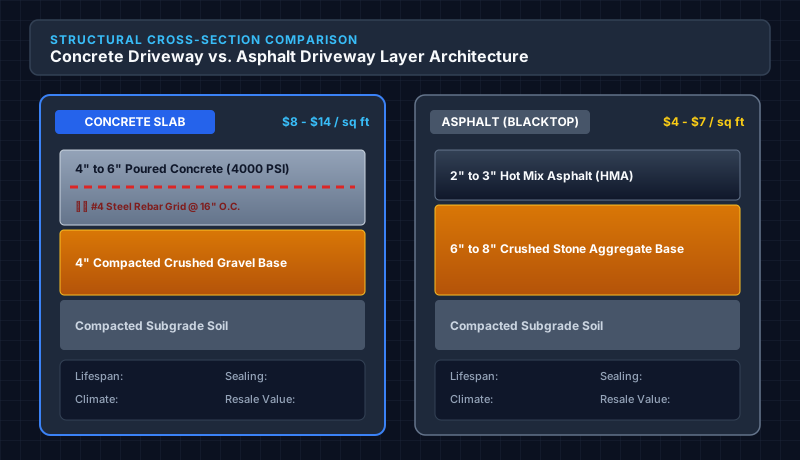
Upfront Installation Costs: Concrete vs. Asphalt Driveway Cost Breakdown
When analyzing the upfront price of concrete versus asphalt, the total cost is divided between excavation, base aggregate, material batching, and skilled finishing labor:
1. Base Preparation and Ground Excavation
Both driveway types require a compacted aggregate sub-base to prevent settling and frost heave:
- Concrete Sub-base: Requires 4 to 6 inches of compacted crushed stone (3/4″ road base). Concrete is a rigid paving material, meaning the concrete slab itself bridges small subgrade voids.
- Asphalt Sub-base: Requires a deeper 6 to 8 inches of compacted crushed gravel. Because asphalt is flexible, any soft spots in the gravel base will immediately cause rutting or wheel depression potholes under vehicle weight.
2. Material and Delivery Costs
- Ready-mix concrete costs between $135 and $185 per cubic yard delivered. A standard 600 sq ft driveway poured 4 inches thick requires approximately 8.0 cubic yards (~$1,200–$1,500 in raw concrete).
- Hot mix asphalt (HMA) costs between $80 and $120 per ton delivered. A 600 sq ft driveway paved 2.5 inches thick requires approximately 8.5 tons of asphalt (~$700–$1,000 in raw material).
3. Labor and Installation Equipment
- Concrete Labor: Involves precise wood forming, placing steel rebar reinforcement or wire mesh, screeding, bull floating, hand edging, cutting expansion control joints, and applying a non-slip broom or decorative finish ($4.50–$7.50/sq ft labor).
- Asphalt Labor: Requires heavy specialized machinery including an asphalt paving spreader and a 3- to 5-ton vibrating steel drum roller to achieve 92%+ compaction density before the material cools below 175°F ($2.50–$4.00/sq ft labor).
How to Compare Lifetime Cost Without a False ROI Promise
Do not choose from a universal 30-year total. Request local bids for both surfaces and compare the same scope: excavation, base depth, drainage, pavement thickness, reinforcement where specified, edges, disposal, permits, warranty, and maintenance. Then use initial price + expected maintenance + likely repairs or resurfacing. Keep low and high scenarios because timing and repair needs are uncertain.
| Input to Compare | Concrete Bid | Asphalt Bid |
|---|---|---|
| Installed scope | Thickness, base, joints, finish, curing | Lift thickness, base, compaction, edges |
| Maintenance | Joint/crack care and any sealer specified | Crack repair and condition-based sealcoating |
| Major repair scenario | Panel repair or replacement allowance | Patch, overlay, or replacement allowance |
| Evidence | Written warranty and local references | Written warranty and local references |
Climate and Weather Durability: Which Performs Better in Your Area?
Cold Northern Climates (Snow, Ice, and Freeze-Thaw Cycles)
Asphalt’s flexibility can be useful in cold climates, while concrete performance depends heavily on air entrainment, drainage, curing, mix design, joints, and deicer exposure. Compare locally specified systems instead of treating material alone as decisive.
- Asphalt is flexible, but it can still crack, ravel, rut, or suffer base and drainage failures.
- The dark black color absorbs solar heat, accelerating snow and ice melt during winter mornings.
- Asphalt does not experience concrete surface spalling, but salts, water, freeze-thaw cycles, and poor drainage can still contribute to pavement and base deterioration.
Hot Southern Climates (Intense Sun and 90°F+ Summers)
Concrete’s lighter surface and rigidity can be useful in hot climates, but mix design, joints, curing, base preparation, and load still govern performance.
- Concrete is generally lighter and more reflective than black asphalt; actual surface temperature varies with color, sun, weather, and finish.
- Asphalt can soften and rut in high heat, especially with concentrated loads or an inadequate pavement/base design.
Aesthetic Versatility and Curb Appeal
- Poured Concrete: Highly customizable with decorative finishes including stamped patterns (slate, cobblestone, ashlar), integral coloring, acid staining, and exposed aggregate stone.
- Asphalt: Uniform matte black appearance. Stamped asphalt and colored acrylic coatings are available but require re-application every 2–4 years to prevent fading.
Summary Checklist: Should You Choose Concrete or Asphalt?
Choose Concrete if:
- You prefer a rigid, customizable surface and accept that joints, cracks, cleaning, and optional sealing may still require attention.
- You live in a warm, southern, or coastal climate with high summer temperatures.
- You want premium curb appeal, decorative patterns, or higher home resale valuation.
- You park heavy vehicles (RVs, boats, work trailers) that could leave ruts in softer asphalt.
Choose Asphalt if:
- You need to minimize upfront project costs ($4–$7/sq ft vs $8–$14/sq ft).
- You have a long rural driveway (e.g., 2,000+ sq ft) where concrete costs would exceed $25,000.
- You live in a severe northern winter climate with heavy road salt usage and deep frost penetration.
Frequently Asked Questions: Concrete vs. Asphalt Driveway
Is concrete really worth double the price of asphalt?
It can be, but there is no universal answer. Compare local bids built to equivalent base, drainage, thickness, and warranty standards, then model maintenance and major repairs as a range. Do not assume a fixed resale-value increase for either material.
How soon can you drive on asphalt vs. concrete after pouring?
You can walk on fresh asphalt within 24 hours and drive passenger cars on it after 2 to 3 days. For concrete, you can walk on the slab after 24–48 hours, but you must wait 7 full days before parking vehicles to allow the slab to reach 70% compressive design strength.
Can you pave asphalt directly over an old concrete driveway?
Yes, asphalt can be paved over old concrete (known as an asphalt overlay or capping) provided the existing concrete base is structurally sound without severe upheaval or sunken voids. All major cracks must be sealed with geotextile fabric beforehand to prevent “reflective cracking” from transferring upward into the new asphalt.
Which is cheaper to repair: concrete or asphalt?
Asphalt is significantly easier and cheaper to repair. Small cracks and potholes can be filled with inexpensive cold-patch or hot-pour rubber ($20–$50 DIY). Concrete cracks are more permanent and harder to blend cosmetically without full panel replacement or slab resurfacing.
Estimate transparency
How this estimate was prepared
- Prepared by
- GoHomeCost Cost Data Team
- Last reviewed
- August 24, 2026
- Update cycle
- Public price inputs checked monthly
Calculation method: Project quantity is multiplied by editable low, typical, and high unit rates. Selected location adjustments, waste, fixed charges, and minimum-job rules are then applied and shown in the result.
Public references used on this page:
This is a planning estimate, not a quote or structural specification. Check product yields, local code, site conditions, and written contractor bids before purchasing materials or building.
Read the full methodology Report a price or calculation issue